Drone path
Flexible on fragmented fields and steep terrain. Useful when tree lines break boom continuity. Throughput falls as continuous hectares grow; battery logistics become the bottleneck.
This page replaces brochure adjectives with working envelopes: tank capacity, flow rate, working width, PTO horsepower class, and spray drift control boundaries. Use it to build an RFQ that engineering can answer without a second discovery call.
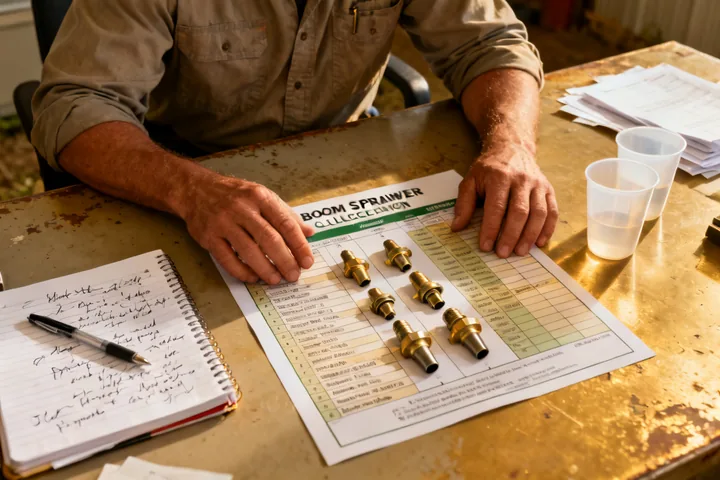
Jacto agronomy specs exist so buyers can reject a unit that fails the envelope — not so marketers can claim every sprayer fits every crop.
When a soybean plan calls for 120 L/ha across 24 m, the boom pack either hits ±5% at the stated speed or it does not. When a citrus block needs airblast volume matched to dense canopy, cannon units either document fan settings or they leave agronomists guessing. We publish the failure modes next to the targets.
Compare measurable envelopes before you open the inquiry modal.
| Parameter | Typical Range | Acceptance Note |
|---|---|---|
| Tank Capacity | 1,200–3,000 L | Match refill logistics to field length |
| Coverage Area | 40–200 ha continuous blocks preferred | Below ~10 ha fragmented plots, review drone or backpack paths |
| Working Width | 18–28 m | Section shut-off required near waterways |
| Flow Rate | 80–120 L/min | Verify with flow cups after nozzle change |
| Engine / PTO | 75–110 hp class | Tractor PTO horsepower must sustain pump load |
| Spray Drift Control | Air-induction + boom height lock | Abort when wind exceeds farm SOP |
| Parameter | Typical Range | Acceptance Note |
|---|---|---|
| Tank Capacity | 12–20 L | HD400-class 4-gallon packs included |
| Working Pressure | 1.5–4.0 bar | Shielded tips for greenhouse beds |
| Battery Duty | 4–6 h continuous | Log discharge curves each season |
| Fit | Spot spray / edges / tunnels | Not a substitute for 24 m boom throughput |
| Parameter | Typical Range | Acceptance Note |
|---|---|---|
| Tank Capacity | 400–2,000 L | Balance against row length |
| Row Spacing | 3–6 m | Deflector map per variety |
| Air Volume | Canopy-density matched | Leaf coverage photos required at handoff |
| Spray Drift Control | Wind cut-out guidance | Document abort threshold in SOP |
Flexible on fragmented fields and steep terrain. Useful when tree lines break boom continuity. Throughput falls as continuous hectares grow; battery logistics become the bottleneck.
Higher hectares-per-hour and mature rate control on large rectangular fields. Requires clear headlands and disciplined spray drift control near boundaries. Poor fit for terraced orchards.
Jacto stocks boom and backpack classes as primary; drone integration is treated as a complementary modality when a grower’s acreage mix demands it. We publish both envelopes so procurement does not pretend one tool wins every RFQ.
Adjacent irrigation choices (drip tape versus center pivot) change refill logistics and buffer zones but do not rewrite nozzle physics — keep fertigation planning on the water team and spray rate control on the sprayer team. Drip tape suits high-value beds with tight wetting patterns; center pivot suits large rectangular blocks where boom refill points can align with pivot towers. Neither irrigation path absolves spray drift control near field edges.
Jacto commissioning sheets list: (1) ambient wind and temperature logged at start; (2) three flow-cup samples per boom section at the planned travel speed; (3) boom height measured at mid-span against crop canopy; (4) L/ha variance calculated before operators leave the yard. Farm managers can re-run the same four steps after nozzle wear season without a vendor present. Spec-desk engineers remain available for remote review of the cup photos when a ticket is opened.
Share crop, hectares, tank preference, and wind constraints — we return filled selection tables.